Anti-Black mob hysteria
Native SonAnti-Black mob hysteria is the public campaign of fear and threatened violence that engulfs Chicago after Mary Dalton’s remains are found in the furnace at the Dalton home. News reports cast Bigger Thomas as a sexual predator as well as a killer, and the accusation rapidly becomes a pretext for sweeping searches, racial retaliation, and demands for his death. The novel presents the panic not as an isolated outburst but as a crisis magnified by the press and enabled by public institutions, against a city already structured by housing segregation and racial inequality.
From a discovery to a public threat
The news that bones had been found in the furnace changes the public account of Mary Dalton’s disappearance into a story of murder, and the reports quickly add an unsubstantiated sexual interpretation. Headlines announce that authorities suspect a sex crime, while the paper describes the missing woman as a kidnapped heiress and identifies Bigger as the fugitive. Bigger reads the allegation as a sentence imposed before his capture: in the public imagination, he has already been defined as a threat who must be eliminated.
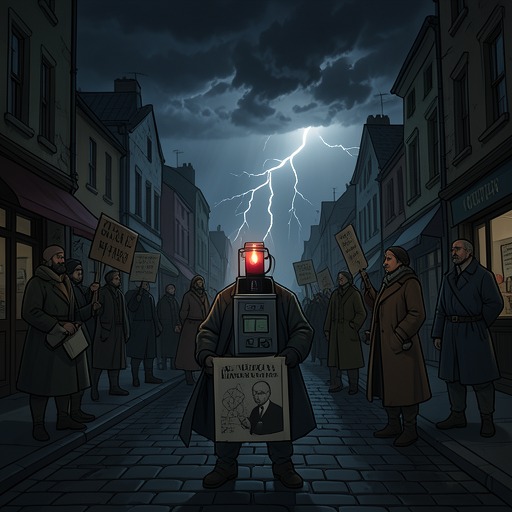
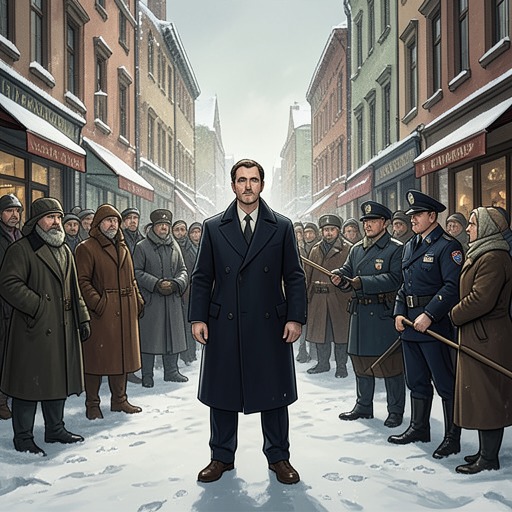
That framing does not remain confined to newspaper language. Reports describe smashed windows in Black neighborhoods, searches of public transport leaving the South Side, and police and vigilantes searching Black homes under a blanket warrant. White parents seek school closures until the accused man is caught; several hundred Black men are detained because they resemble Bigger; and accounts of assaults circulate. The paper also reports Black employees being dismissed across the city, including a cook fired by an employer who fears for her children. The panic thus spreads beyond the manhunt, making Black residents collectively answerable for a crime attributed to one suspect.
The manhunt and its expanding geography
The numbers and maps in the newspaper give the campaign a mobilizing force. One report says that five thousand police, joined by more than three thousand volunteers, have formed a cordon around the Black Belt. Streets, buses, trains, and cars are stopped and searched; the public is warned about possible mob violence even as vigilante groups offer assistance to the police. The paper also suggests that the alleged crime could not have been planned by a Black mind alone, drawing Jan Erlone into suspicion despite reporting that his fingerprints were not found in the Dalton home.
A later map leaves only a small unshaded area within the Black Belt. The accompanying report puts eight thousand armed men in the search and says that more than one thousand Black homes have been entered. Bigger studies the map while hiding in an empty building. For him, the remaining patch is not an abstract diagram: it marks how little space remains outside the search. The image makes the manhunt legible as a collective encirclement, while the accompanying reports join the hunt for Bigger to raids on Communist headquarters and arrests of people described as radicals. Racial suspicion and political suspicion reinforce one another in the public story.
Crowd violence at the Dalton home
When the police bring Bigger back to the Dalton home, the crowd already fills the sidewalks, streets, lawns, and space behind the police lines. People gather to see him, and the crowd’s hostility is audible as he is led from the car through the gates. The scene reverses his earlier arrival at the house: less than a week before, he had stood at its front door humbly with his cap in his hand; now he returns in handcuffs, surrounded by armed officers and watched by a packed crowd.
As the police remove him from the house, the noise rises and members of the crowd call for his death. Outside, a burning cross gives that threat a recognizable racial and political form. Bigger distinguishes it from the Christian cross given to him by a preacher: the symbol before him represents organized racial hatred rather than salvation. The contrast makes the cross a sign of the conflict between religious consolation and the violence directed at him. The crowd’s presence is not simply a background to his arrest; it turns the state’s custody of a suspect into a public spectacle of intimidation.
The trial and Max’s counter-account
The threat continues into the trial. A newspaper reports that the governor has ordered two regiments of the Illinois National Guard to maintain public peace, citing fear of mob violence. Its account also describes rising public demands for the death penalty and anxiety about unrest in the Black community. Military protection establishes the scale of the danger, but the newspaper’s framing also keeps the public’s anger and the prospect of racial conflict at the center of the proceedings.
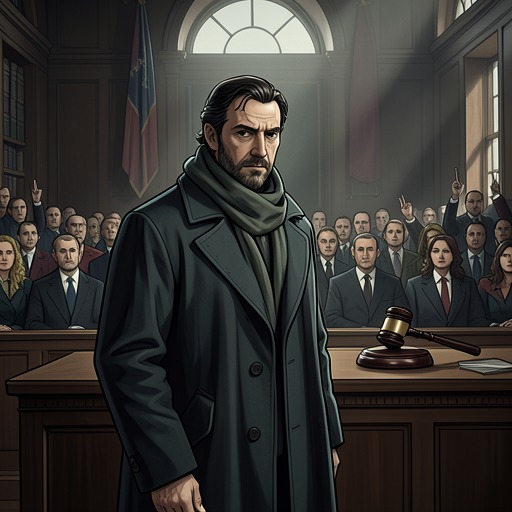
In his address to the court, Max argues that the crowd did not arise spontaneously: in his account, its hostility was incited and then intensified by agencies that spread falsehoods about the danger Bigger and men like him supposedly posed. He connects the agitation to political and commercial interests, naming electoral promises, opposition to relief demonstrations, the use of troops against striking workers, and resistance to new taxes. These are claims made by the defense, not a neutral finding by the court; their significance lies in Max’s effort to make the mob’s formation part of the case rather than treating it as an inexplicable public reaction.
Max also refuses to present Bigger as an innocent victim. Instead, he asks the court to consider the conditions that shaped the life from which the crimes emerged and the fear and guilt that, in his argument, circulate through the wider society. He points to a courtroom where Black spectators sit apart from white spectators without being formally ordered to do so. The arrangement, like the mob outside, reveals segregation operating through both explicit force and learned expectations. His argument shifts attention from the accused alone to the society that produces, interprets, and punishes racialized threat.
Structural context and significance
The panic has a material setting. In questioning Mr. Dalton, Max raises the higher rents charged to Black families for comparable housing and asks whether the real-estate company’s policy keeps them in one South Side area. Mr. Dalton concedes that the policy works that way, while distancing himself from its origin. This exchange does not establish a direct cause for the crowd’s actions, but it places the manhunt within a city whose racial divisions are sustained through housing as well as policing and public representation.
Max develops that context by describing how Black people are restricted in where they may live, study, eat, and work. His speech presents Bigger’s case as inseparable from a wider system that has confined Black life and then reacts to its consequences with fear and punishment. The novel’s earlier recognition of Bigger’s ability to commit violence does not erase the violence of the response around him; neither does the structural critique excuse his crimes. Instead, the mob hysteria makes the unequal terms of public judgment visible: a racialized accusation can become a citywide threat, while the institutions and interests that intensify it remain part of the very order being defended.